
Introduction

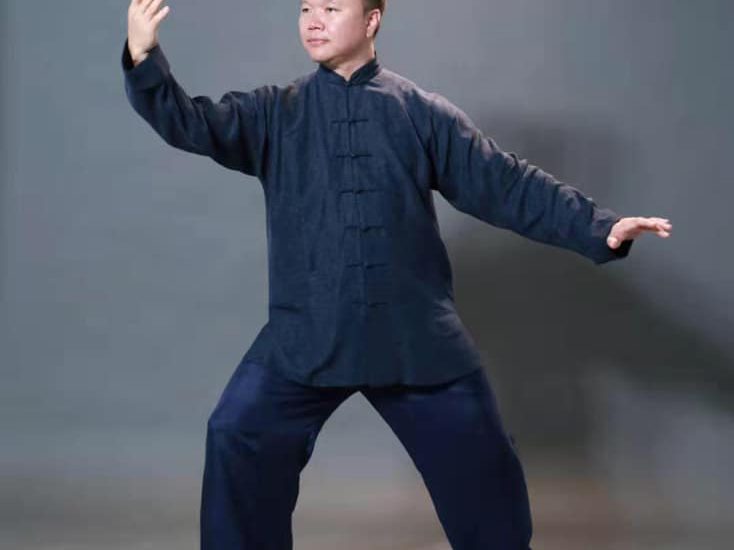
I recently had the privilege of spending a weekend in Austin, TX with my Sifu, Master “Alex” Da De Dong, training and talking about many things, but mostly Dong Family Taijiquan. I was able to clear up a lot of missing or muddled information and get a better understanding of his curriculum.
Master Alex Dong is the oldest great grandson of Dong Ying Jie practicing and teaching Taijiquan, the most senior of the 4th generation within the family.
Having been raised in both China and Hawaii, he is firmly grounded in the traditional and more modern perspective. He understands that westerners aren’t brought up with the same sacrosanct respect for authority and elders and forgives us for being a little looser with the protocols. He still maintains a tight ship with no room for nonsense during class time.
The result is a learning environment that feels safe and comfortable and is conducive to a high-fidelity transmission.
Traditional Curriculum
Dong Ying Jie was an accomplished and famous practitioner who had achieved significant mastery of Wu(Hao) style Taijiquan, learning from the 2nd generation disciple Li Xiang Yuan, before becoming a formal disciple of Yang Cheng Fu, the 3rd generation head of the Yang family.
From this background, Dong Ying Jie put together the Dong family style of Taijiquan.
The main public body of the Dong family curriculum, in addition to an extensive collection of qigong, contains several forms from the Wu(Hao) and Yang lineages.
Specifically:
- Yang Long Form / Slow Set
- Yang Fast Form / Fajin Set
- Wu(Hao) “Ka He” Form / Hard Set
- Dong Family Form / Dong Ying Jie Fast Set / Fast Set
- Weapons: Jian, Dao, stick, double stick, staff, etc
The Yang set is pretty much the standard 108-150 (depending on how you count) with the standard slight lineage/flavor variations from the widely known and practiced Yang Cheng Fu form. Some of the particular details include subtleties such as turning on the weighted leg in some postures, not shifting back before advancing in “Brush Knee and Twist Step” and not keeping the feet parallel in “Step Back to Repulse Monkey”.
The Yang fast set is a usage frame of the Yang set with fajin expression. (This was a creation of Dong Ying Jie, not passed down from the Yang family)
The Wu(Hao) is the traditional form from within that lineage, I am not overly familiar with the widely known or family versions as of yet so can’t make much comment.
The Dong Ying Jie Fast Set is the personal expression of Dong Ying Jie’s art and mastery. It is a lively and powerful form with changes in speed and many expressions of fajin. To a spectator, parts may seem reminiscent of something like a Preying Mantis Beng Bo, but with a distinctly Taijiquan flavor throughout.
The Problem
After teaching and watching his father teach for many years Alex started to notice a pattern. Most people that come to a Taiji class don’t come back for a second.
Among the few that remain, most drop out after a few months.
Some stay, and work diligently for a year or more to master the long form. They reach the kick section and become frustrated. In the struggle they ask, “how much longer is this form” and are told, “well.. you’re ALMOST halfway there”.
For a lot of people, this can be demoralizing. Many of the few dedicated students who have put in a year’s worth of work wind up dropping out because, like all of us, they crave the feeling of having “finished” something.
My own opinion and experience tracks. Those of us that stick around realize that while the “complete” forms are important, working any one piece of it diligently over sufficient time is just as good for your health and self-defense, perhaps better, than poorly practicing an allegedly complete sequence that we rushed to learn for the sake of having finished something.
What’s more, having learned the choreography, there is no guarantee that the student is actually using the principles of Taijiquan to move. Trying to teach that through a long and complicated form sequence can be like putting the cart before the invention of the wheel.
Alex’s Solution
While continuing to review the long form for existing students, Alex has introduced a new curriculum for those beginning their Taijiquan journey with him.
- Fundamental Qigong
- Form 1 – Simplified
- Form 2 – Advanced
- Form 3 – Fajin
- Dong Ying Jie Fast Set / Dong Family Form
- Weapons: Jian, Dao, etc
The Fundamental Qigong is the foundation of his method. While retaining the traditional Dong family qigong exercises for their particular benefit, Master Alex has created and is teaching a new set of Taijiquan specific “hard qigong” to train the body directly in correct Taijiquan method. Three qigong sets of 6 exercises each that heal and prepare the body to actually do Taijiquan instead of a Taiji like dance choreography.
Form 1 – The Simplified Form is essentially the first third of the Yang long form. The main differences being the movements are balanced on both sides like the Beijing competition forms to develop the body evenly, and the length is comparable to the Cheng Man Ching short form, though the specific movements that are omitted are different and it contains no kicks.
Form 2 – The Advanced Form is the rest of the postures from the Yang long form, with fewer repetitions. Practiced together with Form 1 it contains all of the postures from the Yang long form at about 2/3rds the length.
Form 3 is form 1 and 2 performed like the Yang long form fajin set.
The Dong Ying Jie Family form is preserved as in the traditional curriculum.
The weapons forms as ancillary training are also available, particularly the dao for beginners and jian for intermediate students.
While on first glance this seems like a proliferation of forms, in actual practice it is a reduction to necessary fundamentals and a means of targeting the material to the skills and tenacity of the student attempting to benefit from it. The older material is still available for the dedicated student to master.
Content Delivery
Master Alex teaches in New York City most of the time, but usually once a month travels somewhere to teach a growing set of dedicated students around the world.
You can find information about his and his student’s classes and workshops on his website, https://AlexDongTaichi.com
Classes: https://alexdongtaichi.com/classes/
Workshops: https://alexdongtaichi.com/workshops/
Online classes are usually advertised by word of mouth and via his facebook presence: https://www.facebook.com/alex.dong.731
He is very approachable but if you would like an introduction I am happy to help earnest students connect.
Publications
Dong Ying Jie published “Taijiquan Explained” in 1948 laying out his conception of the theory and practice of the art. Until Paul Brennan translated the text and published it on his website, Alex’s translation of the family copy, known as “The Red Book” was the only available version in English.
Even with this alternate translation available, Alex’s “The Red Book” is the only English translation produced by a bilingual direct transmission family member and contains otherwise impossible insight.
He also set out to capture his own original thoughts and understanding in his own “Taijiquan Explained” volume, which sets out the standard considerations of form, theory, and practice as pertains to how the Dong family understands and implements them, as well as his own personal philosophy.
After teaching workshops for a few years, he noticed that students kept having the same questions and same problems and that none of the previous books or writings on Taijiquan adequately expressed them in a way that students could grasp. To solve this problem he wrote “Taijiquan Explained: Workshop Notes”.
If I were forced to pick only one book to study to learn more about Taijiquan, this would be it. It just fills in that many gaps.
All of the books and additional videos covering the new and traditional forms are available for purchase at https://alexdongtaichi.com/store/
Additional digital content is available at https://dongtaichionline.com/shop/
My Experience
Master Alex is a kind and approachable teacher who shares his art freely and generously with his students and anyone else who wants to come to a workshop and pick up some tips and perspective.
Every time I’m able to learn from him I go away feeling a tangible improvement in my Taijiquan.
With plenty of written and filmed material to study between workshops and visits, and an aggressive schedule of online/Zoom courses, it is possible to maintain steady progress in the system, and Alex is easily available to answer questions and offer extra detail.
I strongly recommend his material and courses for students of any level. We can all learn something from this generous and dedicated master.
You can read more about Master Alex all over the internet:
Tai Chi With Alex Dong
Leave a Reply